



Interview By Dooyum Naadzenga
In an era where policies can make or break nations, Anwuli Okwuashi champions evidence-based policymaking as the antidote to guesswork. Drawing on real-world examples from COVID-19 responses to economic forecasting, this interview explores how data analytics drives smarter decisions, overcomes public sector hurdles, and navigates ethical minefields—especially in volatile contexts like Nigeria.
Interviewer: Good day, Ms Okwuashi, and thank you for joining us today
Anwuli: Good day, Mr Dooyum, and thank you for having me.
Q. First, for background context, what does evidence-based policymaking mean today, and why are data and analytics essential?
A. Evidence-based policymaking uses the best available objective evidence, quantitative or qualitative, to inform decisions, rather than relying on ideology, experience, or intuition. It applies rigorous research, analysis, and evaluation to ensure policies are effective, efficient, and fair. Data analytics provides the empirical foundation, helping policymakers accurately identify problems, validate solutions, forecast outcomes, and track impacts. Without reliable data, policies risk bias or outright failure.
Q. How has shifting from intuition to data improved policy effectiveness in key areas?
A. Data-driven approaches yield more targeted, precise policies with higher success rates across sectors. In public health, analytics enhance disease outbreak prevention; during the COVID-19 pandemic, for example, dashboards tracked cases, hospitalisations, and vaccinations, contributing to lower mortality rates compared to intuition-led strategies, as post-pandemic studies confirm. In economic policymaking, big data analytics boost forecasting accuracy and resource allocation, elevating overall planning success.
Q. In your experience, does access to real-time data accelerate and improve policy development?
A. Today’s data landscape dwarfs what we had 10-20 years ago. In addition to administrative data, we have alternative data from our devices, social media, wearables, and IoTs. You name it; data is being collected 24/7, and how these data are received has improved as well. Of course, real-time data improves the speed and accuracy of policy development, because lag and biases are minimised. While we must make provisions to filter out the noise from these data to ensure accuracy, we cannot deny the fact that having access to real-time data helps. Some examples are urban traffic management systems where real-time data is used to improve congestion and inform decision-making on traffic signals, etc. Economic dashboards have also become ubiquitous at every level of government, helping track indicators and giving early warning signs of shocks.
Q. How does strategic forecasting support long-term planning, such as for economic stability?
A. Strategic forecasting forms the backbone of long-term planning, creating roadmaps to navigate future uncertainties. For economic stability, it projects trends in GDP, inflation, unemployment, geopolitical risks, technological shifts, fiscal policies like interest rates, infrastructure spending, and risk mitigation—over 5-20 years. As the adage goes, “If you fail to plan, you plan to fail.” Long-term planning and forecasting are inseparable.
Q. How accurate is predictive analytics, especially amid surprises like COVID-19 or the global financial crisis? How do we handle ‘black swan’ events?
A. The accuracy in models varies by domain and data quality but has increased a lot with advancements in ML. I would like to correct the impression that these global shocks you mentioned came completely as a surprise; there were warning signs that were overlooked. Hindsight, they say, is 20-20; in retrospect, we can see what went wrong, and rather than dwell on why it went wrong, our focus should be on putting systems in place so that it doesn’t happen again. Early models used simple regressions, but now advanced analytics like deep learning, spatial analysis, etc. are more effective in handling dynamics. Black swan events are rare, high-impact events that are hard to predict. Like I mentioned earlier, there were warning signs, but they were not understood. To balance such a thing requires robustness, not just pure prediction. It would be important to develop strategies around situation planning and stress testing: Construct extreme “what-if” scenarios with the view to building resilience. Implement early warning systems that continually scan the anomalies for signals and then combine these ML forecasts with human judgement. We all agree that there are some things that a machine cannot do yet.
Q. What are the biggest obstacles impeding wider analytics adoption?
A. Public sector uptake lags the private sector due to entrenched challenges. First, data silos: over 50% of agencies cite fragmented departmental data and poor inter-agency collaboration, leading to duplicated efforts. Second, talent shortages—many organisations lack in-house IT staff, wasting time on external hiring and bureaucracy. Third, outdated technology: obsolete IT infrastructure blocks modern tools. Fourth, budgetary constraints and leadership disinterest, especially for non-revenue agencies whose essential value often goes unquantified without clear performance metrics.

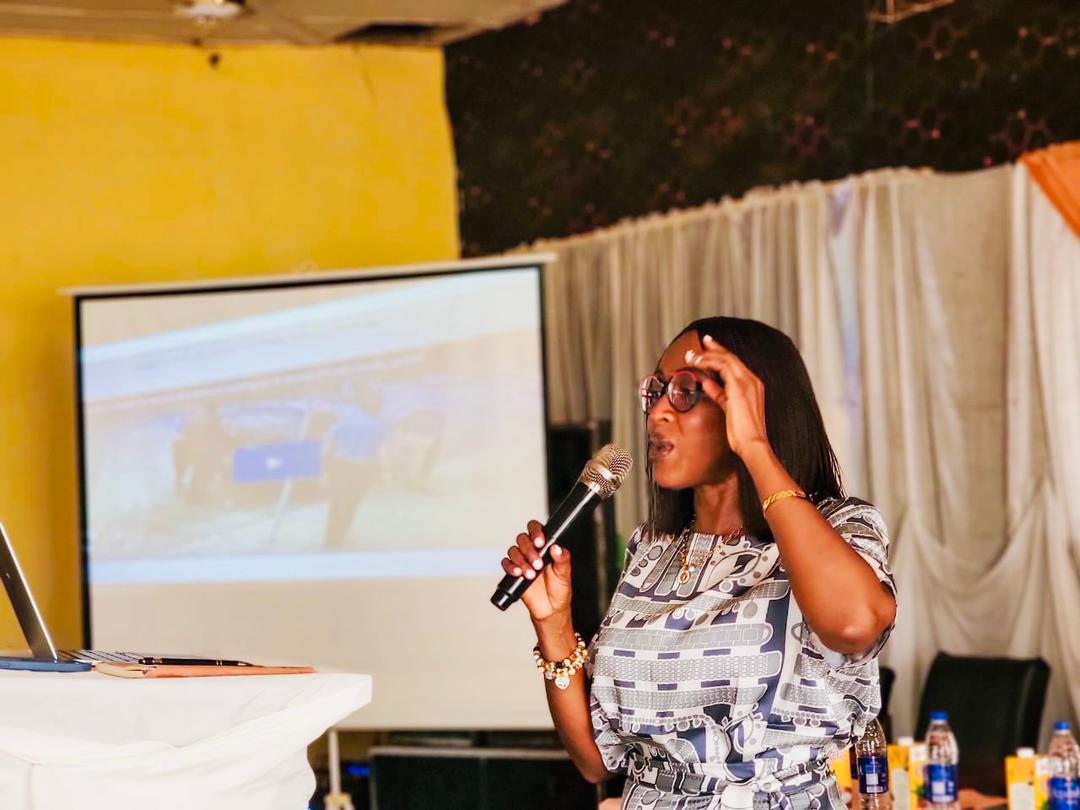
Anwuli Okwuashi, during a presentation on International Women’s Day 2025 at the World Trade Center St. Louis
Q. How can the public sector overcome these challenges to strengthen analytics?
A. Strategic action is key: Prioritise talent investment through academic partnerships, competitive rewards, in-house development, and data literacy training for all. Upgrade infrastructure via cloud platforms and shared services for scalability. Foster leadership and culture—experience can hinder if it resists change; continuous training ensures alignment on collective goals, preventing “not how we’ve always done it” mindsets.
Q. Why is ethics crucial in data and algorithms for policymaking?
A. Ethics is very critical because data and algorithms are at the core of decisions that impact people, sometimes running into millions, and often having the propensity to scale inequity in society and violate rights if left unchecked. These in turn multiply into perpetuated biases, eroded public trust, and discriminatory outcomes with regard to resource allocation. Good ethical governance provides a level of transparency, accountability, and equity that protects against unfair practices or outright harm while maximising benefits to society. Biases can manifest through unrepresentative training data, flawed algorithms, or historical inequities, resulting in skewed predictions that could disadvantage groups, leading to unfair resource distribution, profiling, or exclusion in policies. An example is the bank lending algorithms where US historical data showing higher rates for majority-minority ZIP codes reinforced discriminatory lending, denying fair access to credit.
Q. How can we balance data-driven policies’ benefits with privacy and equity protections, particularly in Nigeria’s volatile environment?
A. Balance requires robust regulations, tech safeguards, and local adaptations. Nigeria’s context—insecurity, economic instability, political divides—amplifies risks, yet data excels in security and service delivery. Frameworks like the EU’s GDPR and Nigeria’s NDPA 2023 mandate data minimisation, consent, and security; we must enforce and refine them with feedback loops. Privacy-enhancing tech like anonymisation enables safe use. Above all, prioritise transparency in data collection, management, and analytics to build trust—clear processes reduce mistrust and grievances.
Q. What future developments do you foresee in advanced analytics and evidence-based practices?
A. I see important changes occurring in areas such as predicting complex outcomes with higher accuracy to proactively act on them, real or near real-time evaluation, and artificial intelligence-powered “dynamic policy cycles” to automatically evaluate and adjust policies. With the adoption of language and text processing, documents that would have taken longer to analyse are completed in seconds by AI, improving efficiency, and integrated systems blend health, economic, and environmental information to ultimately improve lives worldwide.
Anwuli Okwuashi is an economist and researcher passionate about making financial services more accessible for underserved communities. Her work dives into consumer finance systems and smart policy solutions, especially in markets where these tools can truly change lives.







Leave a Reply